Room divider: glass, slats or drywall
Comparing materials for zoning a room or studio flat: glass partition vs wood slats vs drywall. Light, sound, price, installation and reversibility. Guide by REAL GLASS.
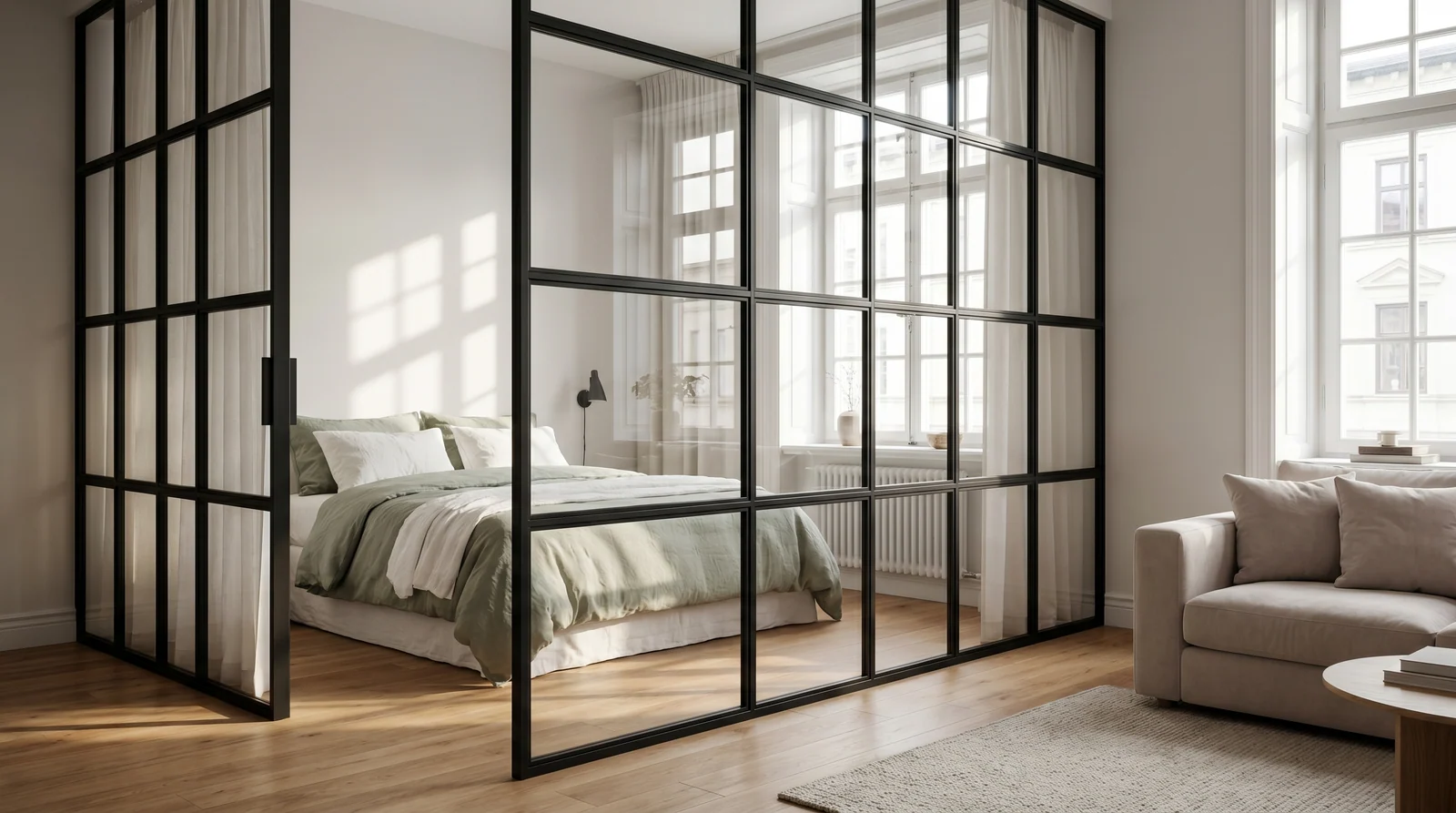
A room divider solves a common task: split a studio flat, a kitchen-living room, or carve out a study without turning the room into a dark corridor. The main question is the material: glass, wood slats or drywall. Each behaves differently for light, sound and reversibility. Let's get to the point. By Armen Arutyunyan, co-owner of REAL GLASS, glass-construction design engineer, 12 years of experience.
01Three zoning scenarios
Before choosing a material, answer three questions: do you need to keep natural light, do you need sound insulation, and how reversible should the solution be (in case you ever want the open space back). The answers decide the material.
02Glass, slats and drywall: comparison
| Criterion | Glass | Slats | Drywall |
|---|---|---|---|
| Lets light through | Fully | Partly | No |
| Sound insulation | Up to 42 dB (double) | Almost none | Medium |
| Privacy | Adjustable (frosting, smart) | Decorative | Full |
| Visual volume | Preserves | Preserves | Reduces |
| Installation | 1 day, clean | 1–2 days | 3–7 days, dust, finishing |
| Reversibility | High (removed in hours) | High | Low (major works) |
| Door in the line | Sliding/hinged glass | Rare | Standard door |
| Upkeep | Wipe down | Dust between slats | Repaint over time |
03When people choose glass
A glass partition is the choice when it's important not to lose light and openness. It physically divides the space, but the eye passes through, so even a small studio doesn't become a set of cramped boxes. Transparency is adjustable: height-based frosting, horizontal bands, tinting, or smart glass that turns opaque at a button.
- Bedroom in a studio — an all-glass or loft partition with a frosted lower section.
- Study / work zone — double glazing for quiet on calls.
- Dressing room — clear or tinted glass with a sliding door.
04When slats fit
A slatted divider is décor and light zoning, not a barrier. It sets a rhythm and partly screens a zone, but it doesn't hold sound or create privacy. It works well as an accent in a living room or hallway, and poorly where quiet or seclusion is needed.
05When you need drywall
Drywall is justified when you need a solid, permanent zone: a separate bedroom with full privacy, niches for appliances, hidden utilities. The downsides — it eats light and volume, the install is dusty and needs finishing, and removing it means another renovation.
06Cost of zoning with glass
| Glass partition type | From |
|---|---|
| All-glass (zoning) | from 9,000 ₽/m² |
| Framed, loft style | from 12,400 ₽/m² |
| Double glazing (sound insulation) | from 16,800 ₽/m² |
| Smart glass (switchable transparency) | from 38,000 ₽/m² |
Price depends on area, glass type, profile and door. We fix the exact quote in the contract after a free measure.
07Common zoning mistakes
- Building a solid wall where a transparent partition would do — the room goes dark.
- Expecting sound insulation from slats or thin single glazing.
- Forgetting the door in the partition line.
- Ignoring ceiling height: loft builds up to 4 m need proper support.
08Ceiling height and support
The taller the partition, the more important the support. For standard 2.6–2.9 m ceilings, fixing to floor and ceiling is enough. In lofts and double-height spaces (3.5–4 m) stiffness must be calculated: an all-glass panel that tall flexes, so we add a horizontal transom or build a framed structure. At the measure the engineer decides whether the ceiling can take the fixing and whether an intermediate support is needed.
09Privacy: levels
| Solution | Privacy | Light |
|---|---|---|
| Clear glass | None | Maximum |
| Frosted band / lower section | Partial | High |
| Full frosting (satin) | Silhouette only | Diffused |
| Graphite tint | Medium | Subdued |
| Smart glass | Switchable | On demand |
A popular scheme for a studio bedroom is "frosted bottom, clear top": you're shielded from view while light and openness remain.
10Cost of ownership
A glass partition needs almost no maintenance — just wipe it down. Drywall needs repainting over time, and slats need dusting between the lamellas. Plus reversibility: a glass structure can be removed in a couple of hours and relocated, whereas demolishing a drywall wall means dust, debris and finishing again. In the long run glass is often cheaper than it seems at the start.
11What to plan before ordering
- Can the floor and ceiling take the fixing (screed, stretch ceiling needs an embed).
- Whether a door is needed and which type — plan it in.
- The desired privacy level and light scenario.
- Room height and whether a transom is needed for tall panels.
12Bottom line
For most studio flats and kitchen-living rooms, glass is the best balance: it divides the space, keeps the light, regulates privacy and is easy to remove. Slats are for a decorative accent, drywall for a solid permanent zone.
REAL GLASS designs and installs glass room dividers in St. Petersburg — from all-glass to loft and smart glass. See glass partitions or book a free measure.