All-glass vs framed partition: which to choose
The two main partition types. Aesthetics, strength, price, install. With office and home cases.
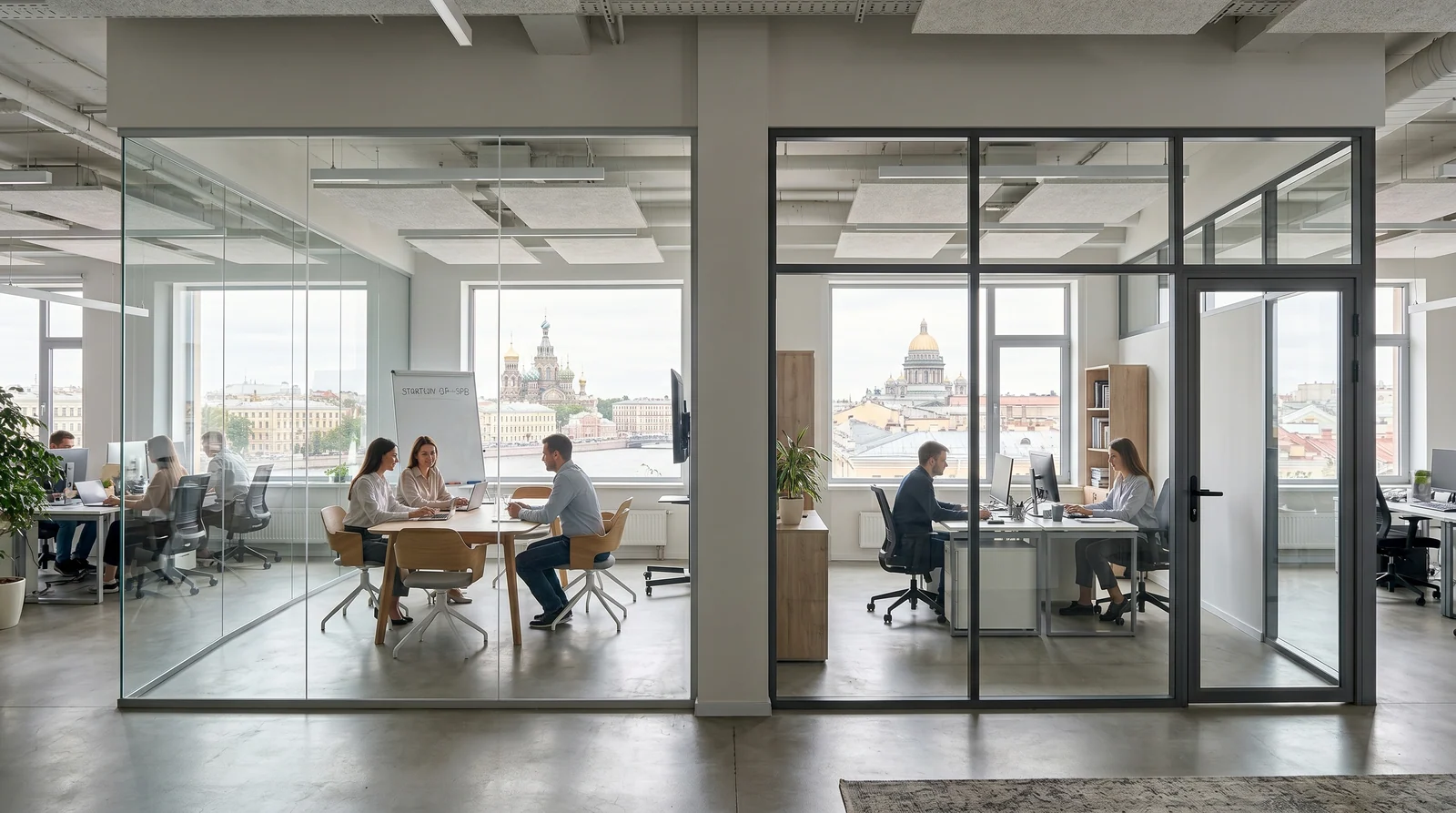
A glass partition is either all-glass (silicone vertical joints) or framed (visible T-profile). Look different, engineer different. Where each works.
01All-glass
Panels join vertically via 4–6 mm clear silicone seam. Top and bottom — concealed aluminium U-profile. No visible vertical profiles.
Pros: max lightweight aesthetic, open-space friendly, up to 4 m height without joints.
Cons: acoustic capped at 32–34 dB by the silicone seam, single-panel replacement is harder, no profile-integrated ventilation.
02Framed (T-profile)
Glass slots into a visible aluminium or steel T-profile. Thin (T-18, T-25) or thick (T-40 for lofts).
Pros: sharp geometry, better acoustics, easier single-panel swap, profile can carry electrical or ventilation.
Cons: visible profiles, demands tighter geometry, 25–35% more expensive.
032026 prices (3 m height)
| Area | All-glass | T-25 | T-40 |
|---|---|---|---|
| 5 m² | from 49 000 ₽ | from 62 000 ₽ | from 78 000 ₽ |
| 10 m² | from 96 000 ₽ | from 122 000 ₽ | from 152 000 ₽ |
| 20 m² | from 192 000 ₽ | from 244 000 ₽ | from 304 000 ₽ |
Real choice often isn't either-or, but hybrid: main partitions all-glass for openness, meeting rooms framed for acoustics. Standard pattern in modern Class A offices.
04This service at REAL GLASS
If you've read this far, the topic is probably relevant to a real project. We make glass partitions in-house in St. Petersburg, with a measure within 1–3 days, 1-year warranty and a fixed contract price. All numbers in this article come from our actual 2026 quotes.
For a project-specific estimate — see the service page or request a free on-site measure.